Outposts Unknown Resources - 55+ Resource Pipeline
How resources work in Star Trek: Outposts Unknown: the researched-harvested-refined-combined-transported pipeline and the four production inputs.
Published October 17, 2026 · Last updated October 17, 2026
Quick Answer: How Does the Resource System Work?
Star Trek: Outposts Unknown tracks over 55 unique resources, and official copy lists exactly what happens to them: "researched, harvested, refined, combined, transported, and finally" used. That six-step chain — with research literally first — is the game's economy in one sentence: every world adds new resources, every resource rides the same pipeline, and your outposts exist to keep that pipeline flowing toward the research mission.
| Pipeline Step | What Happens | Your Job |
|---|---|---|
| Research | Unlock the resource before it appears in your economy | Keep the research facility staffed |
| Harvest | Extract from the world's deposits and biosphere | Match harvesters to local terrain |
| Refine | Raw yields become usable inputs | Refinery supply lines and power |
| Combine | Refined inputs become complex goods | Production chains and storage |
| Transport | Goods move between buildings and outposts | Storage capacity and logistics |
The Four Confirmed Production Inputs
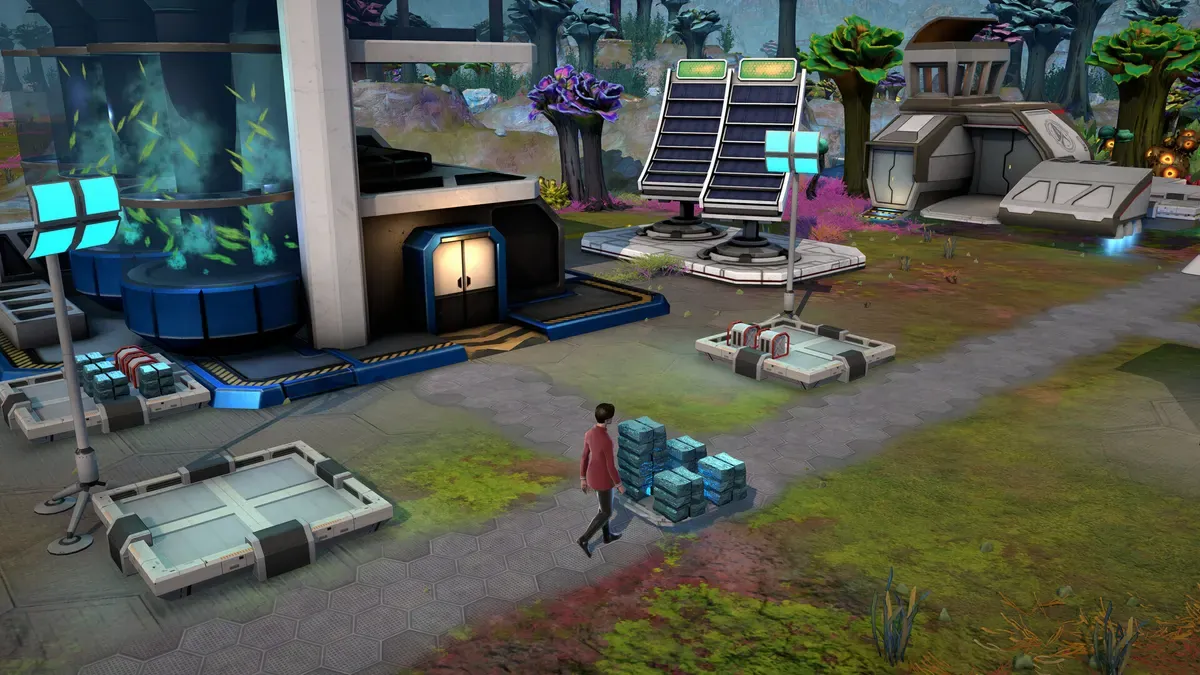
Official guidance names what every production building needs to succeed: "water, energy, processing capabilities, and resource inputs". Treat those as the four meters on your outpost dashboard. Water and energy come from utility structures; processing capability comes from refinery-tier buildings; resource inputs are the chain outputs themselves. A stalled building is always one of the four missing — checking them in order is the fastest diagnosis.
Two Supply Sources: Planet and Ship
Every resource on a world has two possible origins: the planet itself, or your ship. Official example: when local supply cannot feed the outpost, "a shipment of food proteins from the Resonant may be all you need" to keep going. Imports bridge gaps; they do not replace building the local chain — the mission is a self-sufficient research outpost, and cargo capacity is finite.
Named Resources and the Ecology Loop
The developer's Captain's Devlog #3 (September 2026) names real resources on the chain: "From Polyalloy to Duranium, to Dutronic Chips and Memory Banks" — and confirms buildings also draw compute as an upkeep alongside water and power, with the required "pipes and conduits" taking up placement space. The same devlog reveals the ecology rule: harvested biological material comes with seeds you replant, so Starfleet's footprint on each world stays minimal. Harvest, but put it back — that is the confirmed loop.